What is Mensa?
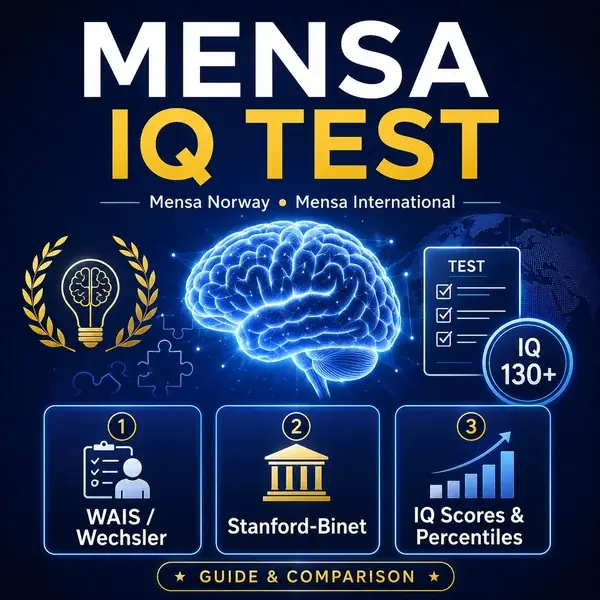
Mensa is the world's oldest and largest high-IQ society, founded in 1946 in Oxford, England by Roland Berrill and Lancelot Ware. The name comes from the Latin word for "table" — the idea being that members meet as equals at a round table of intellect. Today, Mensa has more than 145,000 members across 100+ countries.
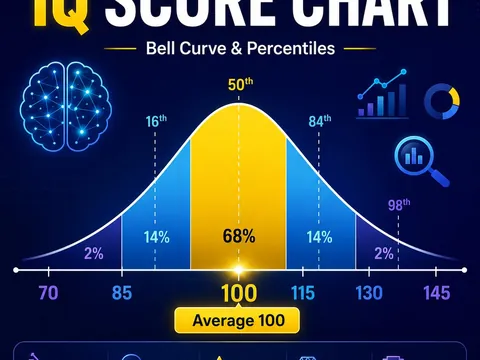
Mensa has just one requirement for membership: scoring in the top 2% of the population on an approved IQ test. That's it. There are no other qualifications — no degree requirements, no age limits, no professional credentials, no application essay. If you can prove a 98th-percentile cognitive ability score, you can join.
This single criterion makes Mensa unique among professional and social organizations. The members are an unusually heterogeneous group — software engineers next to truck drivers, professors next to teenagers, retirees next to entrepreneurs. The only thing all members share is having tested at or above the 98th percentile on a recognized cognitive assessment.
The Mensa qualifying score (130+)
The Mensa qualifying threshold is the 98th percentile — meaning your score must be higher than 98% of the general population. On most major IQ scales, this corresponds to a score of 130 or above, but the exact number depends on the test:
- Stanford-Binet (5th ed.) — 132 or higher (uses SD 16, slightly different from Wechsler)
- WAIS-IV / WISC-V — 130 or higher (SD 15)
- Cattell III B — 148 or higher (uses SD 24)
- Raven's Progressive Matrices — varies by version, generally 130+
- ICAR-based online tests — 130+ as estimate (online scores can vary ±5–10 points)
The reason different tests have different "qualifying numbers" is the standard deviation — the spread of scores. Wechsler scales use SD 15, so a 130 is two standard deviations above the mean. Stanford-Binet 5 uses SD 16, so the equivalent score is 132. Cattell uses SD 24, so the equivalent is 148. All correspond to the same percentile — the 98th.
This is why understanding IQ percentiles matters more than fixating on raw numbers. A 130 on one test and a 148 on another can represent the same cognitive ability — they just use different scales.
How to qualify for Mensa
There are two ways to qualify for Mensa membership:
1. Take Mensa's own supervised test
Each national Mensa chapter administers its own test, usually for a small fee (typically $50–$100). These tests are supervised in person (or, increasingly, via proctored online sessions), administered under standardized conditions, and accepted as definitive proof for membership.
In the US, the American Mensa Admission Test consists of two parts: the Mensa Wonderlic and the Mensa Cognitive Abilities Test. Most other countries use either the Cattell III B or a national variant.
2. Submit prior test scores
Mensa also accepts scores from over 200 approved tests if you've already taken one. Commonly accepted tests include:
- WAIS-IV (Wechsler Adult Intelligence Scale, 4th ed.) — score 130+
- Stanford-Binet (5th ed.) — score 132+
- WISC-V (Wechsler Intelligence Scale for Children) — score 130+
- Cognitive Assessment System (CAS)
- SAT/GRE scores from before certain dates
Online IQ tests like our free IQ test are not accepted by Mensa for qualification. They're useful for self-assessment and as a screening tool, but for membership you need a proctored, recognized test.
The different Mensa tests
"The Mensa test" isn't a single test — it varies by country and chapter:
Mensa Norway (online, free, unofficial)
Mensa Norway hosts a free online IQ test that's widely shared online. It consists of 35 pattern-recognition matrices (similar to Raven's Progressive Matrices) with a 25-minute time limit. Important: the Mensa Norway online test does not qualify you for membership. It's a self-assessment tool. To join Mensa, you still need a supervised test through your national chapter.
Mensa International (no single test)
Mensa International coordinates the global organization but doesn't administer one universal test. Each national Mensa runs its own admissions process. Mensa International maintains the list of accepted tests and qualifying scores.
American Mensa Admission Test
In the US, the test consists of two parts and takes about 2 hours. You can also submit prior test scores for evaluation by mail.
British Mensa — Cattell III B
UK Mensa uses the Cattell III B test, which has a different standard deviation (SD 24) than Wechsler scales. The qualifying score is 148 (Cattell), equivalent to 130 on WAIS-IV.
WAIS-IV vs Stanford-Binet vs Mensa tests
The two "gold-standard" clinical IQ tests are the WAIS-IV and the Stanford-Binet. Both are administered by trained psychologists, take 60–90 minutes, and provide the most accurate IQ scores available. Mensa's own tests are designed for high-throughput screening — faster but more focused.
| Test | Administered by | Duration | Best for |
|---|---|---|---|
| WAIS-IV | Licensed psychologist | 60–90 min | Clinical diagnosis, comprehensive assessment |
| Stanford-Binet 5 | Licensed psychologist | 60–90 min | Wide age range (2–85+), clinical use |
| WISC-V | Licensed psychologist | 60–90 min | Children ages 6–16 |
| Mensa Admission Test | Proctored | 2 hours | Mensa membership |
| Cattell III B | Proctored | 30 min | High-throughput screening |
| ICAR / online | Self-administered | 10–15 min | Self-assessment, screening |
For Mensa qualification, the WAIS-IV is often considered the most accurate option but also the most time-consuming and expensive ($300–$800 with a private psychologist). The Mensa Admission Test is faster and cheaper but only accepted by Mensa itself.
The Cattell Culture Fair test
The Cattell Culture Fair Intelligence Test (developed by Raymond Cattell in 1949) is one of Mensa's most widely accepted tests, particularly in the UK and parts of Europe. As the name suggests, it was designed to be "culture-fair" — using abstract visual patterns rather than language or culture-specific knowledge.
The test consists of four sub-tests:
- Series — completing visual sequences
- Classification — identifying the odd one out
- Matrices — completing pattern grids (similar to our test's spatial reasoning section)
- Conditions — applying rules to visual problems
Because Cattell uses a standard deviation of 24 (rather than the 15 used in Wechsler scales), scores look different. A Cattell IQ of 148 corresponds to a WAIS-IV IQ of 130 — both at the 98th percentile. This is why directly comparing "raw" IQ numbers from different tests is misleading.
How to take a Mensa test
If you want to take an official Mensa test for membership, the process is straightforward:
- Find your national chapter. Visit mensa.org to locate the Mensa branch in your country.
- Register for the supervised test. Fees vary ($50–$100 in most countries). Tests are scheduled periodically — check your local Mensa for dates.
- Take the test under proctored conditions. You'll be in a room with a proctor (or video-monitored online). Standard test conditions apply: no calculators, no breaks during sections, time limits.
- Wait for results. Usually 2–4 weeks. You'll get a pass/fail and may also receive your IQ score.
- If you pass, you'll be invited to join. Annual membership fees vary ($79–$150 depending on country).
If you've already taken a recognized test (WAIS-IV, WISC, etc.), you can usually submit the score directly without retaking. Contact your local chapter for the procedure.
What Mensa membership offers
Once you're in, Mensa offers more than a certificate. The organization runs local and international events — lectures, debates, games nights, regional gatherings (RGs), and an annual world gathering. There are 200+ Special Interest Groups (SIGs) covering everything from quantum physics to Renaissance literature to extreme sports.
Many members report that Mensa membership most valuable for the community — finding peers who share their curiosity and pace of thinking. Others use it primarily as a credential or networking platform. The annual fee is modest ($79–$150 in most countries), and the community can be genuinely enriching.
That said, Mensa isn't for everyone. Some find the cult of cleverness off-putting. Others discover that high IQ alone doesn't make for good company. Like any organization, you get out what you put in.