What is an IQ test?
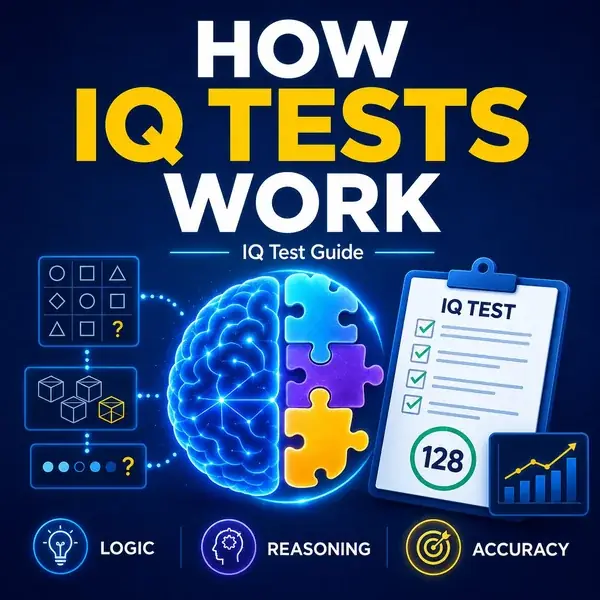
An IQ test (Intelligence Quotient test) is a standardized assessment designed to measure cognitive abilities — your capacity for reasoning, problem-solving, pattern recognition, and abstract thinking. The output is a single number, the IQ score, that places your performance on a population-normed scale centered at 100.
Modern IQ tests typically include several types of tasks:
- Pattern matrices — visual sequences where you identify the next item
- Verbal analogies and vocabulary — language and word relationships
- Number series — numerical patterns and arithmetic
- Spatial rotation — mentally rotating 2D and 3D objects
- Working memory — holding and manipulating information in mind
The exact mix varies by test. Some tests focus heavily on pattern recognition (like our free IQ test based on the ICAR framework). Others, like the WAIS-IV, include broader subtests including processing speed and short-term memory.
A short history of IQ testing
1905 — Alfred Binet and Théodore Simon. The first practical intelligence test was developed in Paris by Binet and his collaborator Théodore Simon. The French government had commissioned them to identify schoolchildren who needed extra help — not to label children as "smart" or "stupid," but to provide targeted support. Binet's test measured what he called "mental age" by giving children age-graded tasks.
1916 — Lewis Terman and the Stanford-Binet. American psychologist Lewis Terman, then at Stanford University, adapted Binet's test for American use. It was Terman who popularized the term "Intelligence Quotient" (IQ), originally defined as (mental age ÷ chronological age) × 100. The Stanford-Binet became enormously influential — and, unfortunately, was used to justify some of the worst pseudoscientific abuses of the early 20th century, including discriminatory immigration policy and forced sterilization.
1939 — David Wechsler and the Wechsler-Bellevue. Wechsler, working at New York's Bellevue Hospital, developed a new approach: rather than computing a quotient, he scored performance relative to age-matched norms. This is the basis of all modern IQ tests. The Wechsler scales — WAIS for adults, WISC for children — remain the clinical gold standards today.
1960s onward — Modern psychometrics. The field evolved rapidly, incorporating insights from statistics, neuroscience, and cross-cultural research. The contemporary CHC (Cattell-Horn-Carroll) theory provides a hierarchical framework for understanding cognitive abilities, and modern tests are calibrated against large, representative population samples.
The field has also reckoned with its troubled history. Today's IQ research carefully addresses bias, fairness, and the limits of what cognitive testing can and can't tell us.
What IQ tests actually measure
IQ tests measure what psychologists call general cognitive ability — the ability to learn, reason, and solve novel problems. They don't measure knowledge per se (though crystallized intelligence, which includes vocabulary and learned facts, is a component). They don't measure motivation, creativity, social skills, emotional intelligence, persistence, wisdom, or character.
What IQ tests do measure — and measure quite well, on a credible test — is cognitive horsepower. The mental machinery that enables you to:
- Recognize patterns in unfamiliar data
- Apply rules to new situations
- Hold multiple pieces of information in mind simultaneously
- Manipulate abstract symbols and relationships
- Learn new domains quickly
These abilities tend to be correlated with each other — people who do well on one type of cognitive task tend to do well on others. This empirical observation gave rise to one of the most replicated findings in psychology: the g-factor.
The g-factor and CHC theory
In 1904, English psychologist Charles Spearman noticed that scores on different mental tests correlated positively. Someone who did well on one type of task tended to do well on others. Spearman proposed that this correlation reflected an underlying general intelligence factor — what he called g.
More than a century later, the g-factor remains one of the most replicated findings in psychology. Massive datasets and sophisticated statistical methods (factor analysis, structural equation modeling) consistently extract a "general" factor that accounts for 40–50% of the variance across cognitive tests.
Modern theory refines this with a hierarchical model — the Cattell-Horn-Carroll (CHC) framework. At the top sits g. Below it are several broad abilities (fluid reasoning, crystallized intelligence, visual processing, processing speed, working memory). Below those are dozens of narrow abilities. Most modern IQ tests are designed to sample broadly across these abilities, then aggregate the results into a single g-loaded score.
What does this mean practically? Two things. First, your overall IQ score is largely a measure of g. Second, your domain breakdown (abstract, verbal, numerical, spatial reasoning) reveals where you stand on the broader abilities — which can vary significantly even among people with the same overall score.
How modern IQ tests are scored
Modern IQ tests use norm-referenced scoring. You don't get a percentage correct — you get a score that reflects how your performance compares to a large representative sample of people your age.
The process works in three steps:
- Raw score — number of correct answers across all subtests
- Standard scaled score — your raw score converted to a scale with mean 10 and SD 3 (per subtest)
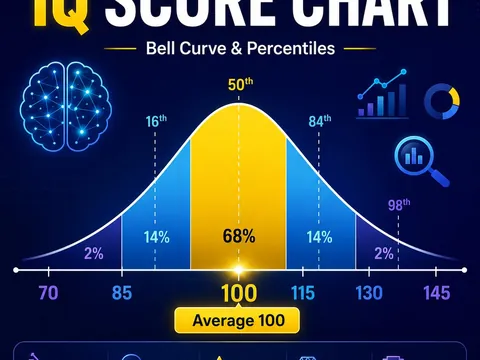
- Composite IQ — your subtest scores combined and converted to the IQ scale (mean 100, SD 15)
This standardization is why IQ scores are comparable across tests. A 115 on the WAIS-IV means the same thing as a 115 on the Stanford-Binet 5 — both represent one standard deviation above the population mean. The conversion handles the math; the bell curve remains anchored.
It's also why the average IQ is always 100. The scale is built that way. When a test is re-normed (typically every 10–20 years), the scoring is recalibrated so the new sample's mean equals 100.
The ICAR framework
The International Cognitive Ability Resource (ICAR) is an open-source collection of validated cognitive test items developed by researchers led by William Revelle at Northwestern University. ICAR was created to democratize psychometric research — to provide researchers, educators, and the public with high-quality items that don't require expensive licensing.
ICAR items have been validated across many independent studies, with correlations of r = 0.70–0.85 with gold-standard clinical measures like the WAIS-IV. That's a strong correlation by psychometric standards.
The ICAR item bank covers four primary domains:
- Letter sets (abstract pattern recognition)
- Number series (numerical reasoning)
- Verbal reasoning (analogies and vocabulary)
- Three-dimensional rotation (spatial reasoning) and matrix reasoning
Our free IQ test uses 33 ICAR-based items distributed across these four domains. The test scoring uses ICAR normative data to convert raw scores into IQ-scale results.
Are online IQ tests accurate?
The honest answer: it depends on the test, and on the conditions under which you take it.
Tests built on peer-reviewed item banks like ICAR can be quite accurate as screening tools. The items themselves are validated; the scoring uses real normative data; the underlying psychometrics are sound. Correlations with clinical tests run r = 0.70–0.85, which is strong.
However, even a perfectly designed online test has limitations:
- No supervision — anxiety, distractions, breaks, looking up answers
- Variable test conditions — fatigue, time of day, environment, screen size
- Self-administered — no clinician to clarify confusing items or notice red flags
- Limited adaptive scoring — clinical tests adjust difficulty based on responses
- Norms may not match your population — ICAR norms are based largely on online samples
The net effect: expect your online IQ score to be accurate to within about ±5–10 points under good conditions, and possibly worse under bad conditions. A high score on a credible online test is meaningful; a single low score isn't reliable evidence of low ability.
Clickbait IQ tests are a different category. Tests that promise unrealistically high scores, claim to "boost your IQ," or charge for results are typically not based on validated items and shouldn't be trusted.
The most accurate IQ tests
For maximum accuracy, the gold standards remain the clinical tests:
- WAIS-IV (Wechsler Adult Intelligence Scale, 4th ed.) — the most widely used clinical IQ test. Administered one-on-one by a licensed psychologist. 10 core subtests, 60–90 minutes. Cost: $300–$800 with a private psychologist; covered by some insurance for clinical purposes. Considered the most accurate available test for adults.
- Stanford-Binet (5th ed.) — slightly older format, wide age range (2 to 85+). Similar accuracy to WAIS-IV. Often preferred for children at the extremes (very gifted or very low scores) because the ceiling and floor are higher and lower.
- WISC-V — Wechsler scales for children ages 6–16. Used widely in gifted-program assessments and learning-difference diagnoses.
- WPPSI-IV — Wechsler scales for preschool ages 2:6 to 7:7.
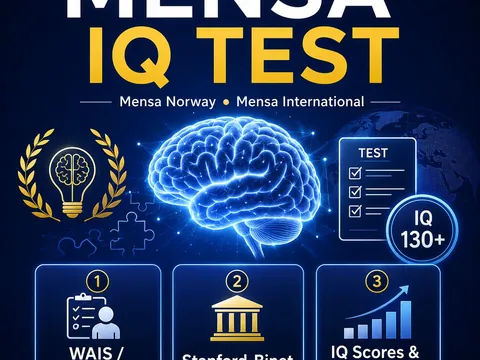
For Mensa qualification specifically, see our Mensa IQ test guide which covers the full list of accepted tests.
How to take an IQ test for the best result
If you want the most accurate result from any IQ test — online or otherwise — follow these guidelines:
- Rest first. Take the test when you're well-slept and alert, not at 11 PM after a long workday. Fatigue alone can drop your score by 5–10 points.
- Eliminate distractions. Quiet room, phone on silent, no music with lyrics, no other open browser tabs. Cognitive performance is exquisitely sensitive to environmental noise.
- Use the right device. A laptop or tablet is best — spatial reasoning matrices need visual detail that's hard to see on phone screens.
- Don't rush, but don't agonize. Your first answer is usually right. If you're stuck after 20 seconds, mark your best guess and move on. Overthinking hurts more than it helps.
- Treat the score as a range. Even under perfect conditions, expect ±5–10 points of variance. The single number is an estimate, not a verdict.
- Pay attention to the domain breakdown. Your strongest and weakest cognitive domains often tell you more than the overall number does.