The shortlist of extremely high IQs
Several people are commonly cited as having the highest measured or estimated IQs in modern times. Note that these scores come from different tests with different scales, methodologies, and reliability:
| Name | IQ (cited) | Context |
|---|---|---|
| William James Sidis | 250–300 | Retrospective estimate, no real records |
| Terence Tao | ~230 | Childhood test, Fields Medalist mathematician |
| Marilyn vos Savant | 228 | Stanford-Binet, listed in Guinness 1986–1989 |
| Christopher Hirata | ~225 | Childhood test, astrophysicist |
| Kim Ung-Yong | ~210 | Korean child prodigy, NASA at age 7 |
| Christopher Langan | 195–210 | Independent thinker, Mega Society |
Important context: scores above about 160 become statistically unreliable. Most standardized tests don't have enough discrimination at the extreme tail to distinguish between, say, 200 and 220. Treat these numbers as approximate.
Terence Tao — the working mathematician
Terence Tao (born 1975) is arguably the most accomplished living mathematician. He won the Fields Medal in 2006, is a MacArthur Fellow, and a UCLA professor. As a child he was tested with an IQ estimated around 230.
What makes Tao's case interesting is that he's been studied and observed extensively as an adult. His cognitive abilities are visible in his work — broad mathematical productivity across multiple subfields, an unusual ability to absorb and synthesize ideas, and a famously generous open-blog approach to mathematical discussion.
Tao himself has been characteristically modest about IQ. He has pointed out that what mattered for his career wasn't the score but consistent hard work, exposure to good teachers, and the freedom to pursue what interested him.
Marilyn vos Savant — the Guinness record
Marilyn vos Savant (born 1946) was listed in the Guinness Book of World Records from 1986 to 1989 under "Highest IQ" with a score of 228 on the Stanford-Binet. The category was eventually retired due to concerns about test reliability at extreme scores.
Vos Savant is best known for her long-running "Ask Marilyn" column in Parade magazine, where she answered logic puzzles and questions. Her most famous public moment came in 1990 when she correctly explained the Monty Hall problem — a probability puzzle — and was publicly disputed by thousands of readers including hundreds with PhDs. She was right; they were wrong.
Her case became central to the academic discussion of whether extreme IQ scores are even measurable. The 228 figure came from a childhood test that had a ceiling at the time. Modern tests are typically capped at 160 or 180 because higher scores can't be reliably distinguished from each other.
William James Sidis — the cautionary tale
William James Sidis (1898–1944) is the most famous "highest IQ ever" case — and the most cautionary. His IQ has been variously estimated at 250, 300, even higher. None of these numbers come from a single reliable test. They're retrospective estimates based on his extraordinary childhood:
- Reading the New York Times at 18 months
- Self-taught Latin and Greek by age 6
- Enrolled at Harvard at age 11
- Gave a lecture on four-dimensional geometry to Harvard mathematicians at 12
But his adult life was difficult. After early academic burnout and public ridicule, he largely withdrew from intellectual life, worked menial jobs, and died at 46 from a cerebral hemorrhage. Sidis is often cited as evidence that extreme cognitive ability alone doesn't guarantee a successful or happy life — and that intense pressure on prodigies can backfire badly.
Why "highest ever" is hard to pin down
At the extreme end of the bell curve, several factors make precise scoring impossible:
- Test ceilings. Most modern IQ tests are capped at 160–180 (WAIS-IV) because higher scores can't be reliably differentiated.
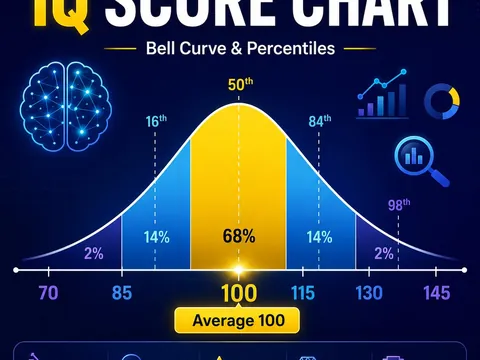
- Statistical thinness. An IQ of 200 corresponds to roughly the 99.99996th percentile — about 1 in 20 million people. The sample sizes needed to validate scoring at that level just don't exist.
- Childhood vs adult scores. Many extreme scores come from childhood tests, which can show inflated numbers when a child performs at adult levels. These don't map cleanly onto adult norms.
- Different test scales. Cattell's SD 24 produces nominally higher numbers than Wechsler's SD 15. Direct comparison is misleading.
The honest answer to "what is the highest IQ ever recorded?" is: we don't really know. There are several plausible candidates, but the precise number is statistical noise.
What it actually means to have a 200+ IQ
Having a 200+ IQ — assuming the score is meaningful at all — predicts certain things and doesn't predict others:
It predicts: rapid learning of complex material, strong abstract reasoning, ability to hold multiple complex variables in mind, success on cognitive tests (somewhat circular but real).
It doesn't predict: achievement, happiness, life satisfaction, social success, financial success, mental health, or creativity. The historical record of extremely high-IQ individuals is decidedly mixed. Some (Tao, Hirata, vos Savant) had distinguished careers. Others (Sidis, Langan) struggled with society and never produced the world-changing work their childhood promise suggested.
For most practical purposes, the difference between 130 and 200 IQ matters less than the difference between conscientiousness, persistence, and luck. Take a free IQ test if you're curious about your own score, but don't over-index on the number.