Did Albert Einstein ever take an IQ test?
No, Einstein never took a formal IQ test. He died in 1955, and modern IQ testing as we know it had only been around for about 50 years. The Wechsler scales (WAIS) — today's gold standard — were developed in 1939, when Einstein was already 60 and a globally famous physicist. He had no reason to subject himself to a cognitive assessment, and no record exists of him doing so.
Every "Einstein IQ 160" or "Einstein IQ 180" claim you see online is a retrospective estimate — someone looking at his accomplishments, his early life, his writings, and guessing what his score might have been if he had taken a modern test. These estimates are interesting but not data.
The number 160 became culturally cemented partly through repeated references in popular media, biography, and trivia compilations. It's not based on any actual measurement.
Where the "160" number comes from
The most commonly cited estimate — 160 — has murky origins. Several pathways led to it becoming the consensus figure:
- Catherine Cox's 1926 study — Cox estimated retrospective IQs for 301 historical figures based on biographical evidence. Einstein wasn't in her sample (he was still alive), but her methodology influenced later estimates.
- Hans Eysenck and others — Various 20th-century psychologists estimated Einstein's IQ in the 160–180 range based on his work patterns and intellectual output.
- Popular trivia compilations — The "160" figure was repeated so often in books and articles that it became the de facto answer.
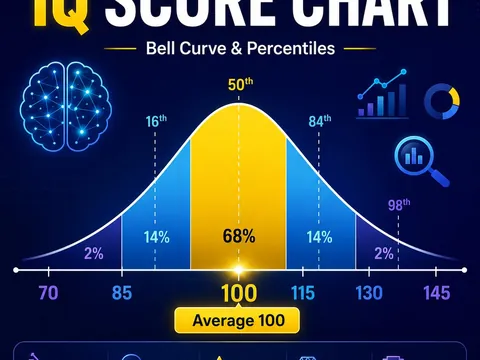
For comparison: an IQ of 160 places you at roughly the 99.997th percentile — about 1 in 30,000 people. An IQ of 180 is closer to 1 in 20 million. Both ranges are statistically reasonable for someone who reshaped physics, but the precision is illusory.
What we actually know about Einstein's mind
Rather than speculate on an unknowable number, we have plenty of evidence about how Einstein actually thought:
Late bloomer in language
Einstein famously didn't speak fluently until he was around 4 years old. His parents and teachers initially worried about developmental delays. This is sometimes used to argue that IQ doesn't fully capture genius, since by any standard he was extraordinary as an adult.
Visual-spatial reasoning
Einstein himself described his thinking as primarily visual and spatial, not verbal. He famously talked about "thought experiments" — imagining riding alongside a beam of light, or visualizing what would happen inside a falling elevator. This is the kind of cognition that modern IQ tests partially capture through their spatial reasoning subtests.
His brain, studied
After Einstein's death in 1955, pathologist Thomas Harvey removed and preserved his brain. Subsequent anatomical studies (in 1985, 1996, 1999, 2012, and 2013) found some unusual features — denser-than-average connections in the corpus callosum, an enlarged inferior parietal lobe (associated with mathematical reasoning), and an unusual pattern of folding. Whether any of this caused his abilities or merely correlated with them remains unknown.
What this tells us about IQ
The Einstein story illustrates several limits of IQ as a concept:
- IQ measures cognitive ability under standardized conditions. It doesn't measure creativity, persistence, intellectual courage, or the willingness to spend years thinking about a single problem.
- Genius-level achievement requires more than high IQ. Many people score 160+ without revolutionizing physics. Einstein's output came from cognitive ability plus deep focus, contrarian thinking, and a willingness to question assumptions everyone else accepted.
- Childhood "delays" don't predict adult ability. Many later-life high achievers were unremarkable or even concerning to their early teachers.
- Retrospective IQ estimates aren't science. They're guesswork dressed up in numerical clothing.
If you want to know your IQ — for real, not retrospective speculation — take a credible IQ test. Even an online test based on validated ICAR items will give you a better estimate than any number assigned to a dead celebrity by a third party.