Free IQ Test Online
Real Score in 10 Minutes
How smart are you, really?
A research-backed online IQ test built on the ICAR cognitive ability framework — the same open-source items used in peer-reviewed cognitive science research. 33 questions across 4 reasoning domains. Real IQ score with percentile rank. Browser-scored, completely free.

Take the IQ Test
Take the test in a quiet, focused environment. Each question has one correct answer — pick the one you think fits best. Your first instinct is usually right. See full instructions.
Loading...
What is an IQ test?
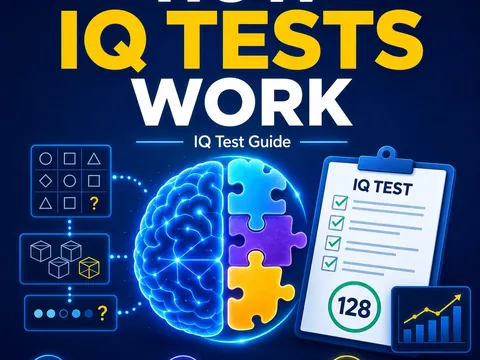
An IQ test — short for Intelligence Quotient test — is a standardized assessment that measures cognitive abilities like reasoning, problem-solving, pattern recognition, and abstract thinking.
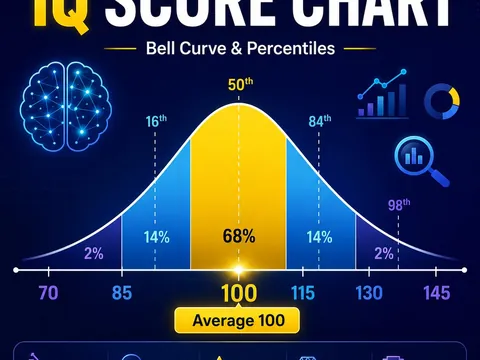
The term "Intelligence Quotient" was coined by German psychologist William Stern in 1912, originally as a ratio of mental age to chronological age. Modern IQ tests, however, are no longer literal quotients — instead, they use statistical norms to place your performance on a bell curve. The population mean is set at 100, with a standard deviation of 15. About 68% of people score between 85 and 115; only about 2% score above 130 (a common Mensa qualifying score).
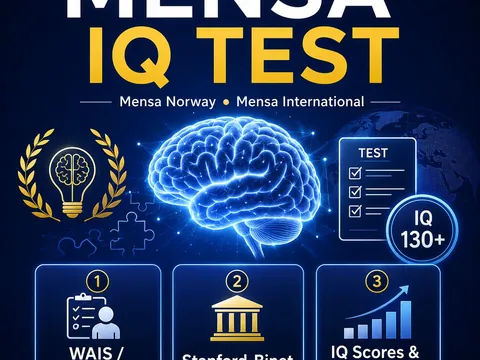
Most modern IQ tests measure what psychologists call general intelligence, or the g-factor. This is typically broken down into two broad components: fluid intelligence (your ability to reason through novel problems) and crystallized intelligence (your accumulated knowledge, vocabulary, and expertise). Clinical IQ tests like the WAIS-IV (Wechsler Adult Intelligence Scale) and the Stanford-Binet remain the gold standards — but online tests built on the open-source ICAR framework can serve as solid screening tools.
This page hosts a free 33-question IQ test based on ICAR items. It takes about 10 minutes and returns a real IQ score with percentile ranking and a per-domain breakdown. Take the test now, or read on for more about how IQ scoring works.
Why choose this free IQ test?
A credible IQ assessment that respects your time, your privacy, and your intelligence.
Built on the ICAR Framework
Based on the International Cognitive Ability Resource — an open-source, peer-reviewed assessment validated across thousands of participants. Read more.
About 10 Minutes
33 carefully designed questions across 4 cognitive domains. Long enough to be meaningful, short enough to hold your focus.
No Sign-Up Required
Start immediately. No email, no account, no hidden fees. The test runs entirely in your browser — your answers never leave your device.
Instant IQ Score & Percentile
Scored client-side using ICAR normative data. Your IQ score, percentile rank, and domain breakdown appear the moment you finish.
Four cognitive domains of intelligence
Each domain captures a distinct facet of general intelligence (the g-factor).
Pattern recognition, logical deduction, and sequence completion. Tests your ability to identify rules and relationships in novel information. This is the strongest single marker of fluid intelligence.
Vocabulary, verbal analogies, and word relationships. Tests your capacity to understand language and reason with verbal information — a marker of crystallized intelligence.
Mathematical problem-solving and quantitative logic. Detect patterns in numerical data, perform mental arithmetic, and apply quantitative reasoning to novel problems.
Visual pattern matrices, mental rotation, and spatial transformation. Manipulate two- and three-dimensional patterns in your mind. The bulk of this test and a strong fluid-intelligence indicator.
IQ score chart: what your score means
The standard WAIS-IV classification system places scores on a bell curve centered at 100. For deeper interpretation, see our full IQ score chart guide.
| IQ Range | Classification | Percentile | Description |
|---|---|---|---|
| 130+ | Very Superior | Top 2% | Mensa-qualifying range. Exceptional cognitive ability — common among researchers and high-level professionals. |
| 120–129 | Superior | Top 6–9% | Well above average. People in this range thrive in intellectually demanding fields. |
| 110–119 | High Average | Top 16–25% | Above the population mean. Common among university graduates and knowledge workers. |
| 90–109 | Average | 25th–75th | The broad middle of the bell curve, where roughly half the population falls. |
| 80–89 | Low Average | 9th–25th | Below the mean but within the normal range. |
| 70–79 | Borderline | 2nd–9th | Significantly below average. May warrant further evaluation if accompanied by functional challenges. |
| Below 70 | Extremely Low | Bottom 2% | Scores in this range may indicate intellectual disability when accompanied by significant limitations in adaptive functioning. |
How to take an IQ test accurately
Test conditions matter as much as the test itself. Follow these four steps for the most accurate result.
Prepare your environment
Find a quiet space free from distractions. Turn off notifications. Take the test when you're well-rested and alert — fatigue can lower your score by 5–10 points.
Use the right device
A tablet or laptop is best — spatial reasoning matrices benefit from a larger screen. Phones work too, but visual detail is easier on bigger displays.
Trust your first instinct
On pattern-recognition tasks, your initial answer is usually correct. If you're stuck after 20 seconds on a single question, mark your best guess and move on.
Interpret your score as a range
Your overall IQ is the headline, but the domain breakdown is the real story. Treat the number as ±5–10 points — not a precise verdict on your intelligence.
Looking for an IQ test for kids? Children's cognitive development requires age-appropriate norms. See our IQ test for kids guide with tests calibrated by age.
Average IQ by Country
Based on data from over 1.39 million test takers worldwide. The population-weighted global average is 100.
Cross-country IQ comparisons have well-documented methodological limitations — test cultural bias, the Flynn Effect, and large within-country variation all matter. Read our full guide on IQ by country for the complete context.
Join 10,000+ curious minds on Telegram
Daily brain teasers, weekly cognitive science breakdowns, and discussions on what intelligence really means. Free, no fluff.
Open Telegram ChannelIQ test FAQ — common questions
Everything you might want to know about this free IQ test, how it works, and what your score means.
What is an IQ test?+
How accurate is this free IQ test?+
How long does the IQ test take?+
Is this IQ test really free?+
How to take an IQ test accurately?+
What does my IQ score mean?+
What is a good IQ test score?+
Where can I take an IQ test?+
Are online IQ tests accurate?+
What does an IQ test measure?+
What cognitive domains does this IQ test cover?+
How is the IQ test scored?+
Do I need to sign up or give my email?+
Can I take this IQ test on my phone?+
Can I retake the IQ test?+
How does this compare to WAIS-IV or Stanford-Binet?+
What is the highest IQ ever recorded?+
Can IQ change over time?+
Is IQ the same as intelligence?+
What happens to my IQ test data?+
Educational tool, not clinical assessment
This is an educational screening tool for personal reflection — not a clinical IQ assessment. Factors like fatigue, test anxiety, screen size, language background, and practice effects can all shift your score by 5–10 points or more. Standardized clinical tests like the WAIS-IV and Stanford-Binet must be administered by a licensed psychologist. If you need a formal evaluation, consult a qualified professional. Based on the ICAR framework (Condon & Revelle, 2014).