Why children need different IQ tests
Adult IQ tests measure cognitive abilities that have largely stabilized. A 30-year-old's vocabulary, abstract reasoning, and processing speed are roughly what they'll be at 35, 40, or 50 — barring significant life events. But children are developmentally moving targets. A 6-year-old's brain is dramatically different from a 12-year-old's, which is dramatically different from a 16-year-old's.
An IQ test designed for adults would be useless for a 5-year-old — and would systematically over- or under-estimate true ability. That's why children's IQ tests are age-normed: they compare your child's performance to peers of the same age, not to adults.
This is also why our online IQ test is calibrated for adults (16+) only. We don't offer testing for kids because age-appropriate norms require careful psychometric work that an online tool can't reliably provide.
Age-appropriate IQ tests
The major clinical IQ tests come in age-specific versions, each calibrated against age-matched population samples:
Preschool (ages 2:6 to 7:7)
WPPSI-IV (Wechsler Preschool and Primary Scale of Intelligence). Designed for children too young for school-age tests. Uses simpler vocabulary, picture-based items, and shorter testing sessions. Often the test of choice for early gifted-program identification.
Kindergarten and early elementary (ages 5–9)
The WPPSI-IV covers up to age 7:7. From age 6 onward, the WISC-V becomes available. Most gifted programs and learning-difference evaluations at this age use one of these two.
School-age (ages 6–16)
WISC-V (Wechsler Intelligence Scale for Children, 5th edition) is the most widely used IQ test for school-age children. 10 core subtests, takes 60–90 minutes. Used for gifted screening, learning difference diagnosis, and clinical assessment.
Teen (ages 16+)
At 16, children transition to adult tests. The WAIS-IV becomes available, and clinical psychologists usually administer this from late high school onward.
Wide age range (2 to 85+)
Stanford-Binet 5 covers nearly the full lifespan, ages 2 to 85+. Often preferred for highly gifted children because it has a higher ceiling than the Wechsler scales.
WISC-V and WPPSI-IV — clinical gold standards
The Wechsler scales for children are the most widely used pediatric IQ tests in clinical practice. The WISC-V (school-age) and WPPSI-IV (preschool) both follow the same general structure as the adult WAIS-IV, scaled for younger cognitive development.
The WISC-V measures cognitive ability across five primary indexes:
- Verbal Comprehension — vocabulary, similarities, comprehension
- Visual Spatial — block design, visual puzzles
- Fluid Reasoning — matrix reasoning, figure weights
- Working Memory — digit span, picture span
- Processing Speed — coding, symbol search
These combine into a Full Scale IQ (FSIQ) — the headline number — plus the five index scores that show your child's cognitive profile.
Both tests are administered one-on-one by a licensed psychologist. They take 60–90 minutes and cost $300–$800 with a private practitioner. Many schools provide testing for free if it's needed for special education services (under IDEA in the US).
What an IQ test for kids measures
A children's IQ test measures roughly the same cognitive abilities as an adult test — pattern recognition, verbal reasoning, working memory, processing speed — but framed in age-appropriate ways. A 6-year-old doesn't get analogies about "ephemeral" and "transient"; they get picture-based matching tasks.
What the test reveals:
- Cognitive strengths and weaknesses — where your child excels and where they might need support
- Learning style indicators — verbal vs visual learners, fast vs deliberate processors
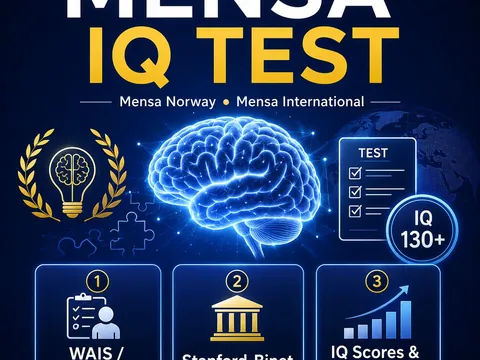
- Giftedness identification — scores at 130+ qualify for most gifted programs
- Learning difference patterns — discrepancies between subtests can suggest dyslexia, ADHD, or specific learning disabilities
- Educational placement — sometimes used to determine appropriate grade level or program
What it doesn't measure: creativity, emotional intelligence, motivation, social skills, or character. These matter enormously for a child's success and happiness, and they're not what an IQ test is designed to capture.
Average IQ by age
One of the most common questions parents ask is whether children's IQ scores change with age. The short answer: not by much, on average, after age 6 or 7. IQ scores tend to stabilize by middle childhood and remain relatively consistent into adulthood.
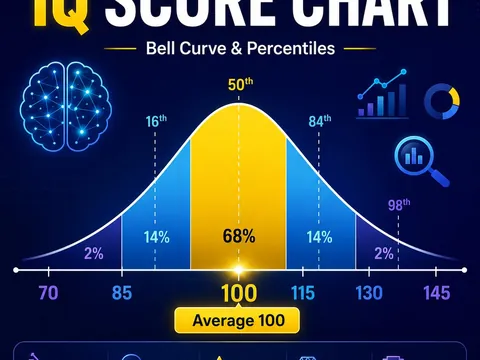
By definition, the average IQ at every age is 100 — because IQ tests are normed against same-age peers. A 6-year-old with IQ 110 isn't necessarily "smarter" than an 8-year-old with IQ 105 in absolute terms; they each score higher than peers of their own age.
That said, individual scores can shift somewhat with development:
- Ages 3–6: Scores are most variable. A 3-year-old's IQ score is only a weak predictor of their score at age 10.
- Ages 7–11: Scores become much more stable. Test-retest correlations approach 0.80.
- Ages 12+: Scores are highly stable into adulthood, with test-retest correlations approaching 0.90.
This is why most school gifted programs don't formally identify children before age 6 or 7. Earlier scores carry too much measurement noise to be reliable.
When professional testing makes sense
Most children don't need formal IQ testing. But there are situations where it's genuinely useful:
Giftedness identification
If your child seems significantly ahead of peers — reading early, asking complex questions, learning rapidly — formal testing can confirm giftedness and open doors to gifted programs, acceleration, or specialized schools.
Learning differences
If your child is struggling academically despite obvious intelligence, IQ testing can identify specific patterns (e.g., low processing speed with high verbal IQ) consistent with dyslexia, ADHD, or other learning differences. These diagnoses can unlock accommodations and targeted support.
Educational placement
Some schools require IQ testing for placement decisions — gifted programs, special education services, or grade acceleration. In these cases, the school often provides the testing free.
Clinical concerns
If you have concerns about developmental delay, intellectual disability, or significant cognitive issues, comprehensive evaluation by a licensed psychologist (which typically includes IQ testing) is essential.
Conversely, testing just to know "how smart is my kid?" is usually not worth the cost. A satisfied curiosity is rarely worth $500–$800 plus several hours of testing — especially given that the result doesn't change anything about your child's day-to-day life.
Signs your child might benefit from testing
If you're unsure whether testing is worth pursuing, here are signs that often indicate genuine value:
Possible giftedness
- Reading independently before kindergarten
- Asking abstract or philosophical questions early
- Intense, focused interests in specific topics (animals, history, math)
- Boredom and frustration in age-appropriate school settings
- Unusual memory for facts and details
- Sophisticated humor and vocabulary for their age
Possible learning differences
- Significant gap between verbal expression and written work
- Trouble with reading despite obvious intelligence
- Inconsistent academic performance — strong in some areas, weak in others
- Difficulty following multi-step instructions
- Trouble with attention and focus that interferes with learning
- Anxiety around schoolwork that seems disproportionate
If you see several of these patterns, talk to your pediatrician, your child's teacher, or a child psychologist. They can help you decide whether formal evaluation is warranted.
Online IQ tests for kids: a warning
Most "free IQ tests for kids" you'll find online are not credible. They typically have:
- No age-appropriate norms — items designed for adults presented to kids
- No published psychometric properties (no validity or reliability data)
- Heavy bias toward giving high scores (because it keeps users engaged)
- Often a paywall to "unlock" the results — a clear sign of clickbait
A score from one of these tools shouldn't be taken seriously. If you want a real assessment of your child's cognitive abilities, the only credible path is a licensed psychologist using the WISC-V, WPPSI-IV, or Stanford-Binet 5.
That said, low-stakes IQ-style puzzles can be fun and educational. Pattern matrices, logic puzzles, and brain teasers help develop cognitive skills regardless of their accuracy as "tests." Just don't treat the resulting "score" as meaningful.